Creating A Rhythm For Life
We are leaning towards the end of summer now, and while some of us are still enjoying the heat and unstructured vacations, others of us are beginning to long for our regular routines to return in the fall. But before the classes, workload, carpool and after school activities start piling up, it is important for us to take a pause with God to consider how our schedules are leading towards or away from the flourishing that God has for us in our lives. We all desire God’s fruit in our lives– His peace, patience, kindness, goodness, gentleness, faithfulness, love, joy, self-control and rest. The Spirit produces these fruits, but we all have a choice to partner with God in creating space and conditions for these fruits to grow. This month, we are going to look at creating a “Rhythm of Life” where we invite God to help us set intentional rhythms that lead towards God’s flourishing for us.
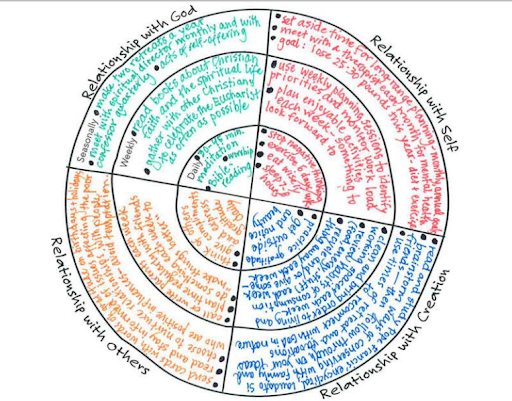
A “Rhythm of Life” could look a little different for everyone. For some people it might be a 1-2 page list of habits and routines, for others it could be created more artistically, as a wheel divided into the different categories of your life or even a vision board. But the end goal of this exercise is to have a basic plan (that can be tweaked as you go!) for daily, weekly, monthly, quarterly, and yearly habits that serve you in each area of your life. You will want to revisit this rhythm at least once a year, or perhaps when a big change in your life is occurring, because the point of these rhythms is that they adapt as we move through diverse seasons of our lives.
Here are the basic steps to creating a “Rhythm of Life”:
Set aside a block of time for this activity and put it on your calendar. Ideally, you’d block off at least a few hours by yourself. This could be on a personal retreat, it could be in the quiet of your own room, it could be somewhere outdoors where you connect with God. If you can’t block off half a day, consider breaking this activity into one hour chunks of time over the course of a week. There’s no magic amount of time to spend; the idea is just that you leave enough space to process your life with God honestly without feeling rushed.
Whether digitally or on paper, write out these basic categories of your life:
Relationship with God
Relationship with Others
Health/Body (Physical, mental, etc.)
Community/Church
Vocation/School/Volunteer/Dreams (Where you invest significant amounts of time or where you’d like to be spending your time)
Before you begin looking at each area of your life, you might consider praying with God over this specific season of your life. Ideally, what would a flourishing look like for YOU in THIS season? Draw, write, or envision that. Are there verses, promises, values or passions He is putting on your heart? Write down any verses or images that come to mind that might create a structure or anchor for the plans God has for you in this season.
Sit with God with each of these categories and ask the following questions:
What would flourishing look like in each of these categories? (For instance, as a parent, in my workplace, in my relationship with God, in my friendships, in my ministry or church?)
What is going well here? Where do I see flourishing already?
What habits or routines am I already doing that are creating space for God’s flourishing?
What is not going well here? Where am I feeling stuck, empty, irritated, overwhelmed, anxious, or desolate?
What habits or routines might God be inviting me to begin that would foster more health and flourishing in these areas? What dreams or plans have I put off that He might be inviting me to invest in? (Art, ministry, business, relationships, etc?)
What current habits, activities or rhythms do I need to STOP doing in this season? (Sometimes we need to learn to say more “nos” in order to make space for the “yes” God has for us now.)
As you consider what habits God wants you to incorporate into your life, try to break these rhythms out into different time categories:
Daily/Several days a week
Weekly
Monthly
Quarterly/Semi-yearly
Yearly
This allows you to think in both small and big picture, and enables you to be practical about what you can commit to. (For instance, as a parent who wants to invest in your kids, you might be able to commit to a one-on-one date with each kid once a month, but you can commit to daily checkins with each kid to make sure they feel seen and loved. In your relationship with God you might commit to 15 minutes of reading the Bible each day, plan a weekly time of rest or Life Group time, and a quarterly personal retreat to help you reset and find clarity throughout the year.)
Create your Rhythm of Life as a document, board, wheel, etc. Whatever you decide to create, make sure that it includes tangible actions and that it works for YOUR personality. Print or create your rhythm and put it somewhere that you can see it or revisit it often.
Once a year, revisit this rhythm and invite God to shift, rearrange, or replace routines as you move into different seasons of your life. You might also consider revisiting this sooner if you face big life changes that impact your rhythms, including a job change, health diagnosis, family addition or relationship change, etc.
A couple of final notes as you work on your rhythms. First, although we can take intentional steps to partner with God’s flourishing in our lives, we will still experience difficult and painful things in our lives. We can’t control all of our circumstances or other people’s actions in our lives, and creating a rhythm of life doesn’t guarantee that our life will magically be protected from hard or broken experiences. It is meant rather to be another way to surrender our lives to God and say yes to Him intentionally.
Second, even though much of this project is something you will want to process on your own with God, I encourage you to include significant people in your life in this process. For instance, if you are looking to create more flourishing in your relationship with a spouse, friend, or child, ask them what habits or rhythms would make them feel seen, valued, or loved. Allow this activity to help you become curious and listen well to others, to God, and to yourself.
Finally, these rhythms of life are not primarily about productivity, but fruitfulness. If you craft a rhythm that becomes burdensome or impossible to maintain, revisit the exercise and let God cut or adjust areas.
If you are looking for a couple of examples, here are a few resources you can check out!